Solar street lights often appear simple: a panel, a lamp, a controller, and a battery. Yet battery life depends on how these parts work together. In many installations, batteries may serve for several years, but there is no universal lifespan. Chemistry, operating temperature, charging quality, discharge depth, and daily lighting hours all matter. A lithium iron phosphate battery usually tolerates more cycles than many lead-acid options, though the right choice depends on budget and site conditions. Cold winter nights and long cloudy periods can change the picture.
This guide explains what affects solar street light battery life and how to judge performance before failure leaves a path dark. It also covers How to extend battery life in solar street lights through practical steps: correct system sizing, suitable charge settings, clean panels, secure connections, and periodic checks for swelling, corrosion, or unusual voltage drops. Small maintenance details count. A controller log can reveal repeated deep discharge before the battery stops working. Still, monitoring is not a substitute for good design. Even well-maintained batteries age, and replacing them too early wastes money. Replacing them too late risks unreliable lighting. The useful answer is not one promised number, but a realistic estimate based on battery type, local weather, load, and the manufacturer's cycle data. We will look at those factors plainly, including the limits of common lifespan claims.
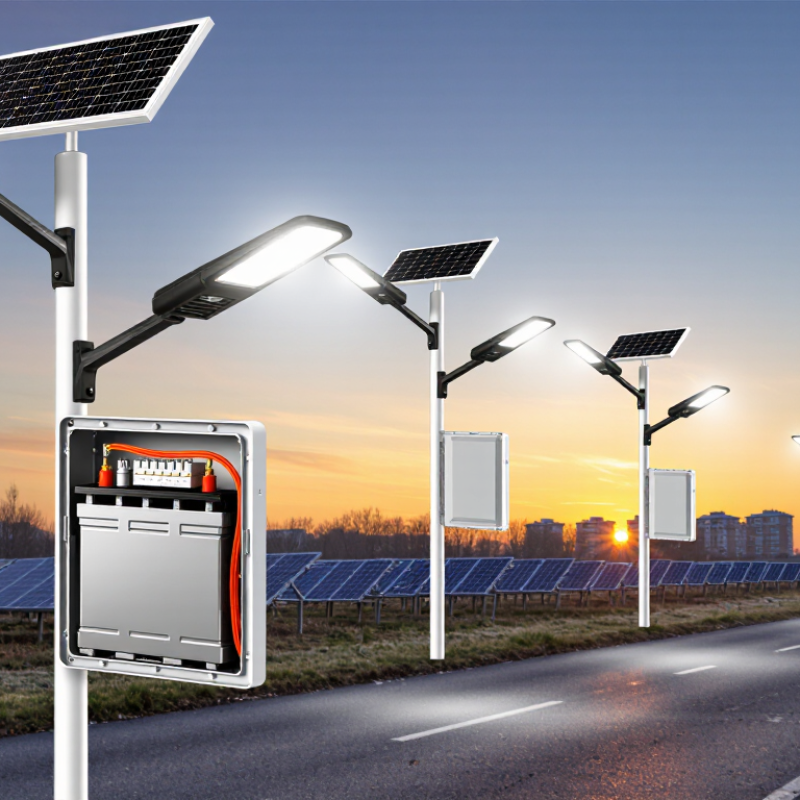
What Does Solar Street Light Battery Life Mean?
Solar street light battery life can mean two different things, and confusing them leads to poor estimates. One meaning is nightly runtime: how many hours the lamp can operate after a full daytime charge. The other is service life: how many years the battery retains enough capacity before replacement becomes practical. These are not interchangeable. An eight-hour runtime does not tell you whether the battery will last three winters or six.
To assess runtime, compare usable battery energy, measured in watt-hours, with the lamp’s actual power draw and control schedule. Dimmed output after midnight, motion-based settings, and cloudy days all change the result.
For service life, review the battery chemistry, charge limits, operating temperature, and cycle rating. Heat is easy to overlook: a battery in a sun-warmed enclosure may age faster than one in a cooler, ventilated housing.
The label alone is not enough. Check nighttime voltage and capacity across different seasons, while noting that dust, panel angle, and local weather can affect the readings. A catalog figure is a useful reference, not a guarantee.
How Long Do Solar Street Light Batteries Typically Last?
Solar street light batteries typically last about 3 to 8 years. The exact lifespan depends on battery chemistry, daily charging, and local weather. Lithium iron phosphate batteries often serve for 5 to 8 years under suitable conditions. Lead-acid batteries commonly last around 2 to 4 years. These are practical ranges, not guarantees. That range is real.
Battery life is often judged by how much energy a battery can still store, not by whether it switches off completely. A gradual loss of capacity may cause dimmer lighting or shorter operation before dawn. Frequent deep discharges can speed up wear, especially when cloudy days prevent a full recharge. High temperatures also stress batteries, while cold conditions can temporarily reduce available capacity. Small details matter.
For a useful estimate, check the battery’s chemistry, rated cycle life, and warranty conditions. Then compare those figures with the site’s actual charging pattern. A lamp that runs through long winter nights may age faster than one in a sunny location. Keep the battery enclosure clean, dry, and ventilated, and inspect connections for corrosion. A neat estimate can still be wrong; even a shaded panel or loose cable can change the charging history.
What Is Solar Street Light Battery Life? How to Extend It — How Long Do Solar Street Light Batteries Typically Last?
| Battery type |
Typical service life |
Typical cycle life* |
Common depth-of-discharge guidance |
Ways to help extend battery life |
| Flooded lead-acid |
About 3–5 years |
About 500–1,000 cycles |
Often kept near or below 50% for longer life |
Avoid deep discharge; use a suitable charge controller; keep terminals clean; check electrolyte level where applicable; ensure safe ventilation. |
| AGM lead-acid |
About 3–5 years |
About 500–1,000 cycles |
Around 50% is a common longevity-oriented target |
Use the correct charging profile; prevent prolonged undercharging and overcharging; keep the battery within its specified temperature range. |
| Gel lead-acid |
About 4–6 years |
About 700–1,200 cycles |
Often kept near or below 50% for longer life |
Use a gel-compatible controller setting; avoid excessive charging voltage and deep discharge; protect the battery enclosure from heat and water ingress. |
| Lithium iron phosphate (LiFePO₄) |
About 8–12 years |
About 2,000–5,000+ cycles |
Often supports deeper discharge; follow the battery maker’s limits |
Use a compatible battery-management system and charger; observe low-temperature charging limits; avoid sustained high heat and unnecessary full discharge. |
|
Important: These are broad industry ranges, not guarantees. Actual life depends on battery quality, daily charge and discharge, system sizing, climate, installation, and maintenance. Cycle-life figures vary with test conditions and depth of discharge. Keep the solar panel unobstructed, size the system for local sunlight and lighting demand, and follow the battery and controller specifications.
|
Which Factors Affect Solar Street Light Battery Life?
Solar street light battery life depends heavily on temperature, discharge depth, charging conditions, and battery sizing. Heat is especially damaging: a battery in a sun-baked metal enclosure may age faster than one kept within its specified operating range. NREL’s 2014 lithium-ion life-prediction study models how temperature, state of charge, and cycling affect capacity loss. It uses 80% remaining capacity as an end-of-life benchmark, not a universal replacement rule.
Depth of discharge matters nightly. If a small battery is drained almost completely before dawn, repeated deep cycles can shorten its useful service life. Poor sizing makes this worse: several cloudy days may leave the battery undercharged, while a mismatched controller can also disrupt charging. NREL’s photovoltaic and storage operations guidance emphasizes checking battery operating conditions and system performance, not just panel output.
Installation details count. A shaded panel, dusty glass, or a loose cable can reduce daily charging; a hot battery compartment can quietly accelerate wear. Check the enclosure temperature and review charge records through changing seasons. One practical complication: a light that still turns on may already have lost substantial storage capacity. The exact effect varies with chemistry and design.
How Can You Tell When a Solar Street Light Battery Is Failing?
A failing solar street light battery often shows a change in its nightly pattern. The lamp may shine normally at dusk, then grow dim or switch off hours earlier than usual. It may also struggle after a clear, sunny day. Watch the pattern. One dark night proves little; several short nights deserve attention. Cold weather, long periods of cloud, or a new lighting schedule can also reduce runtime without indicating battery failure.
Check simple causes before blaming the battery. Dust on the panel, nearby shade, loose wiring, or a faulty controller can limit charging. Note the weather and compare the light’s operating hours over several nights. If the panel receives good sunlight but the lamp repeatedly fades early, ask a qualified technician to test battery capacity under load. A single voltage reading can be misleading. Physical swelling, leakage, or unusual heat needs prompt professional attention; do not handle a damaged battery. Battery aging is gradual, but field checks are not perfect, and I would not replace one based on a hunch alone. Keep dated runtime notes, even if they are a little messy.
Typical Solar Street Light Battery Life
Typical service-life estimates vary with temperature, charge and discharge cycles, depth of discharge, and maintenance. A battery may be failing if the light dims or switches off earlier than usual, fails to stay lit through the night, or shows reduced runtime after a full sunny-day charge. These signs can also result from a faulty panel, wiring, or controller, so check the whole system before replacing the battery.
How Can You Extend the Life of a Solar Street Light Battery?
A solar street light battery lasts longer when it is correctly sized for the lamp’s nightly energy use and local weather.
Consider several cloudy days, not just a clear summer afternoon. Match the battery chemistry and capacity to the charge controller, and use the charging settings specified for that battery. Factory defaults are not always suitable. Avoid repeated deep discharge; a correctly configured low-voltage cutoff can help prevent it. Heat is the enemy. Keep the battery compartment dry and within the battery’s recommended temperature range, with enough airflow where the design allows it. Trapped heat can speed up capacity loss.
Routine checks catch small problems early.
Every few months, inspect cable connections for looseness, corrosion, or cracked insulation, and clear dirt from the solar panel so it can recharge effectively. Review operating data or check battery voltage with a suitable meter, especially after long cloudy periods. A weak battery is not always the cause of dim lights; a shaded panel, faulty connection, or changing load can look similar. That distinction is easy to miss. Keep simple records of charging, outages, and service dates, then compare performance across seasons. Follow the battery maker’s maintenance instructions, since sealed and flooded battery types need different care. Even with good maintenance, capacity gradually falls, and replacement may eventually be necessary.
Conclusion
Solar street light battery life refers to how long a battery can store and deliver enough energy to power a light through the night. Its service life varies with battery type, operating temperature, charging conditions, depth of discharge, and the quality of the system’s solar panel and controller. Over time, reduced capacity may cause lights to dim, switch off earlier than usual, or fail to stay on after cloudy days. These signs can indicate that the battery needs inspection or replacement.
How to extend battery life in solar street lights starts with choosing a battery suited to local weather and lighting demands, then keeping the solar panel clean and unobstructed so it can charge effectively. Correct controller settings help prevent overcharging and excessive discharge, while regular checks can reveal loose connections, corrosion, or changes in nighttime performance. Avoid exposing the battery to unnecessary heat or deep, repeated depletion, and follow the manufacturer’s maintenance guidance. With proper sizing, installation, and care, a battery can deliver more reliable lighting and remain useful for longer.

 Star Lighting